Reflection
The Reflection pattern closes the compound-learning loop. After productive work in a graph, a reflection node distills source memory keys (notes, drafts, observations) into atomic SemanticFacts and persists them to your memory store via an injected MemoryWriter. Future runs retrieve those facts (filtered by tags) through memoryRetriever and feed them into agent prompts as a ## Relevant Memory section.
The infrastructure under reflection — @cycgraph/memory’s temporal knowledge graph and the orchestrator’s memoryWriter / memoryRetriever adapters — is the same. What reflection adds is the node that ties the workflow’s runtime output to that store at the right point in the graph.
How it works
Section titled “How it works”flowchart LR subgraph R1["RUN 1 — cold start"] direction LR Goal1[Goal 1] --> Researcher1["🔬 Researcher\n(memoryQuery.tags)"] Researcher1 -- "research_notes" --> Reflect1["🪞 Reflection\n(rule_based)"] end
Reflect1 -- "writes facts (tags + provenance)" --> Store[(MemoryStore)]
subgraph R2["RUN 2 — with prior knowledge"] direction LR Goal2[Related Goal] --> Researcher2["🔬 Researcher"] Researcher2 -- "research_notes" --> Reflect2["🪞 Reflection"] end
Store -- "memoryRetriever({ tags })" --> Researcher2
Reflect2 -- "writes new facts" --> StoreEach run follows the same loop:
- Productive nodes (research, write, analyse) produce output into workflow state.
- The reflection node reads
sourceKeysfrom state, extracts facts, attaches tags + provenance, and callsmemoryWriter. - On the next run, agents whose nodes declare
memoryQuery: { tags: [...] }have those facts rendered into a## Relevant Memorysection in their system prompt.
When to use this pattern
Section titled “When to use this pattern”- Long-running research agents that should improve as they accumulate domain knowledge.
- Support / triage workflows where lessons from past tickets should inform new ones.
- Compounding pipelines where every run adds vetted facts to a shared knowledge graph.
- Domain bootstrapping — extract a corpus of starter facts from a seed conversation, then have agents query that corpus.
(If you only need ephemeral per-run memory, just use WorkflowState.memory — no reflection node required. If you want cross-run learning specifically, this is the pattern.)
Implementation example
Section titled “Implementation example”Reflection requires two pieces of infrastructure outside the graph: a memory store (where facts live) and a MemoryWriter adapter the runner calls. The graph itself just declares a reflection node.
1. Memory store + writer + retriever
Section titled “1. Memory store + writer + retriever”import { InMemoryMemoryStore, InMemoryMemoryIndex, retrieveMemory,} from '@cycgraph/memory';import type { MemoryWriter, MemoryRetriever,} from '@cycgraph/orchestrator';
const memoryStore = new InMemoryMemoryStore();const memoryIndex = new InMemoryMemoryIndex();
const LESSON_TAG = 'graph:research-v1';
// Tracks which write scopes have already been persisted. The runner passes// the same `idempotency_key` (`run_id:node_id:iteration`) when a write// repeats for the same node execution — after a node retry or crash// recovery — and a writer that ignores it duplicates facts in long-term// memory on every retry.const writtenScopes = new Map<string, string[]>();
const memoryWriter: MemoryWriter = async (facts, options) => { const scope = options?.idempotency_key; if (scope && writtenScopes.has(scope)) { return { fact_ids: writtenScopes.get(scope)! }; // already written — dedupe }
const ids: string[] = []; for (const fact of facts) { const stored = { id: crypto.randomUUID(), content: fact.content, source_episode_ids: [], entity_ids: [], provenance: { source: fact.provenance.source, created_at: new Date(), run_id: fact.provenance.run_id, node_id: fact.provenance.node_id, }, valid_from: new Date(), tags: fact.tags, }; await memoryStore.putFact(stored); ids.push(stored.id); } if (scope) writtenScopes.set(scope, ids); return { fact_ids: ids };};
const memoryRetriever: MemoryRetriever = async (query, options) => { const result = await retrieveMemory(memoryStore, memoryIndex, { tags: query.tags ?? [], max_hops: 0, limit: options?.maxFacts ?? 20, min_similarity: 0, include_invalidated: false, }); return { facts: result.facts.map((f) => ({ content: f.content, validFrom: f.valid_from })), entities: result.entities.map((e) => ({ name: e.name, type: e.entity_type })), themes: result.themes.map((t) => ({ label: t.label })), };};2. The graph
Section titled “2. The graph”The researcher node carries memoryQuery: { tags: [LESSON_TAG] } so the retriever fires before its prompt. The reflection node lives after it and writes back with the same tag.
import { createGraph, GraphRunner } from '@cycgraph/orchestrator';
const graph = createGraph({  name: 'Learning Research Agent',  description: 'Research with compound learning across runs',  nodes: [    {      id: 'research',      type: 'agent',      agentId: RESEARCHER_ID,      readKeys: ['goal', 'constraints'],      writeKeys: ['research_notes'],      memoryQuery: { tags: [LESSON_TAG], maxFacts: 20 },    },    {      id: 'reflect',      type: 'reflection',      readKeys: ['research_notes'],      writeKeys: ['research_notes_reflection'],      reflectionConfig: {        sourceKeys: ['research_notes'],        extractor: { type: 'rule_based', minSentenceLength: 25 },        tags: ['lesson', LESSON_TAG],      },    },  ],  edges: [{ source: 'research', target: 'reflect' }],  startNode: 'research',  endNodes: ['reflect'],});
const runner = new GraphRunner(graph, state, { memoryWriter, memoryRetriever });
Extractor variants
Section titled “Extractor variants”The extractor discriminator on reflectionConfig picks the strategy:
rule_based
Section titled “rule_based”Deterministic sentence-level extraction. Splits the concatenated source memory values into sentences, filters by minSentenceLength, dedupes (case-insensitive), emits one fact per unique sentence. No LLM call — free and predictable.
extractor: { type: 'rule_based', minSentenceLength: 25 }Use when source content is already structured as discrete sentences (agent notes, bullet lists).
Calls an extractor agent that distills the source into a bounded list of atomic, generalisable lessons. Each fact lands with provenance.source === 'agent'.
extractor: { type: 'llm', agentId: REFLECTOR_ID, maxFacts: 5, instruction: 'Extract methodology lessons only.', // optional override}Use when source content is freeform prose, or when you need the LLM to filter what’s worth keeping.
Core concepts
Section titled “Core concepts”Tags scope retrieval
Section titled “Tags scope retrieval”The tags field on reflectionConfig is applied to every fact written by the node. When a downstream node declares memoryQuery: { tags: [...] }, only facts carrying at least one matching tag come back. Namespace tags by graph (graph:research-v1), category (methodology, failure), or both. This lets multiple graphs share a memory store without polluting each other’s retrieval.
Entities and the knowledge graph
Section titled “Entities and the knowledge graph”reflectionConfig.entityKeys declares memory keys whose values name entities the produced facts relate to. The reflection executor reads those values and includes them as entity references on each written fact so the lesson stays reachable via entity-driven retrieval (memoryQuery: { entityIds: [...] }).
Sanitising facts before persistence
Section titled “Sanitising facts before persistence”Reflection writes whatever the extractor produces. If your agents handle PII, customer data, or anything sensitive, those values can land in the long-lived memory store. The factSanitizer hook on GraphRunnerOptions runs once per fact between extraction and the writer call. Returning null drops the fact; returning a modified fact substitutes it.
Fact content is also injection-sanitized automatically before persistence (the same denylist applied to memory before prompt embedding), closing a cross-run stored-injection channel — tainted external text distilled into a “lesson” can’t carry instruction-override payloads into a future run’s prompt.
import type { FactSanitizer } from '@cycgraph/orchestrator';
const EMAIL = /\S+@\S+\.\S+/g;const PHONE = /\b\d{3}[-.\s]?\d{3}[-.\s]?\d{4}\b/g;
const factSanitizer: FactSanitizer = (fact) => {  let content = fact.content;  if (EMAIL.test(content)) content = content.replace(EMAIL, '[email redacted]');  if (PHONE.test(content)) content = content.replace(PHONE, '[phone redacted]');  return { ...fact, content };};
const runner = new GraphRunner(graph, state, {  memoryRetriever,  memoryWriter,  factSanitizer,});
The sanitizer fails closed by default: if it throws (a downed PII service, a buggy regex), the fact is dropped rather than persisted unredacted — a transient outage must not silently leak PII into durable, cross-run memory. Set factSanitizerFailMode: 'pass' on GraphRunnerOptions to restore fail-open behavior (write the original fact on error) when reflection availability matters more than redaction guarantees.
Capping reflection cost with budget
Section titled “Capping reflection cost with budget”LLM-based reflection (extractor: { type: 'llm' }) can run away on long source content. Combine reflectionConfig.extractor.maxFacts with a per-node budget to cap both output size and spend:
{ id: 'reflect', type: 'reflection', readKeys: ['research_notes'], writeKeys: ['reflect_reflection'], reflectionConfig: { sourceKeys: ['research_notes'], extractor: { type: 'llm', agentId: REFLECTOR_ID, maxFacts: 5 }, tags: ['lesson'], }, budget: { maxTokens: 20_000, maxCostUsd: 0.05, },}Breaching either cap throws NodeBudgetExceededError — the reflection fails fast and downstream code can decide whether to skip persistence or retry with cheaper settings.
Cost considerations
Section titled “Cost considerations”rule_basedextraction is free (no LLM call). It’s the right default for most reflection use cases.llmextraction costs one extractor call per run. CapmaxFacts(default 10) to bound output token cost.- The retriever side is free if your memory store is in-process. Production stores (
DrizzleMemoryStore) cost a single Postgres + pgvector query per node-with-memoryQuery.
Production swap
Section titled “Production swap”The example uses InMemoryMemoryStore. Swap to the Postgres-backed adapter when lessons need to survive process restarts:
import { DrizzleMemoryStore, DrizzleMemoryIndex } from '@cycgraph/orchestrator-postgres';
const memoryStore = new DrizzleMemoryStore(db);const memoryIndex = new DrizzleMemoryIndex(db);// memoryWriter and memoryRetriever stay identical
The Postgres schema has a tags jsonb column on memory_facts (migration 0013_add_fact_tags) and uses tag intersection for retrieval.
Eval-gated retention (verified lessons)
Section titled “Eval-gated retention (verified lessons)”By default every reflection fact persists forever. Eval-gating closes the loop: a lesson is kept only if runs that used it verifiably scored better.
The lifecycle is tag-driven:
candidate ──(runs with it beat the baseline)──▶ verified │ ├──(runs with it score worse)──▶ invalidated 'eval-gate:harmful' └──(max_trials, no lift)───────▶ invalidated 'eval-gate:no_lift'Three pieces wire it together:
1. Tag new lessons as candidates — purely a config change:
reflectionConfig: { sourceKeys: ['critique'], extractor: { type: 'rule_based', minSentenceLength: 25 }, tags: ['lesson', 'graph:my-graph-v1', 'candidate'], // ← on trial}2. Pass fact IDs through your retriever and attribute outcomes — the runner records which facts were injected into each run’s prompts (memory._lesson_provenance). After scoring the run however you like (evals harness, business KPI, LLM judge), feed the ledger:
import { getInjectedFactIds } from '@cycgraph/orchestrator';import { InMemoryOutcomeLedger, retrieveGatedLessons } from '@cycgraph/memory';
const ledger = new InMemoryOutcomeLedger();
// Retriever: verified-first, with exploration slots so candidates accrue trials.// Passing `id` through is what makes attribution work — see the foot-gun below.const memoryRetriever: MemoryRetriever = async (query) => {  const facts = await retrieveGatedLessons(store, {    tags: query.tags ?? ['lesson'],    max_facts: 10,    candidate_slots: 4,    rest_after_trials: 5,  // bench fully-trialled candidates: frees slots AND creates baseline runs    ledger,                // in-progress-first — trial cohorts graduate instead of churning  });  return {    facts: facts.map((f) => ({ content: f.content, validFrom: f.valid_from, id: f.id })),    entities: [],    themes: [],  };};
const finalState = await runner.run();const score = await scoreRunSomehow(finalState);  // your metric, normalised to [0,1]await ledger.recordOutcome({  run_id: finalState.run_id,  score,  fact_ids: getInjectedFactIds(finalState),});
3. Run the gate periodically:
import { evaluateRetention } from '@cycgraph/memory';
const report = await evaluateRetention(store, ledger, {  min_trials: 3,          // evidence required before any decision  promote_margin: 0.05,   // lift over leave-one-out baseline → verified  evict_margin: 0.05,     // drop below baseline → evicted as harmful  max_baseline_runs: 40,  // undecided by then → retired as no-lift  // (max_trials alone can't fire here: rest_after_trials freezes trials)});// report.promoted / report.evicted / report.held — each with `evidence`
Eviction is a soft delete (invalidated_by), recoverable via findFacts({ include_invalidated: true }). The lift heuristic is correlational — facts are co-injected and run difficulty varies — so min_trials and the margins are the guardrails, not a causal proof.
How much evidence does the gate need?
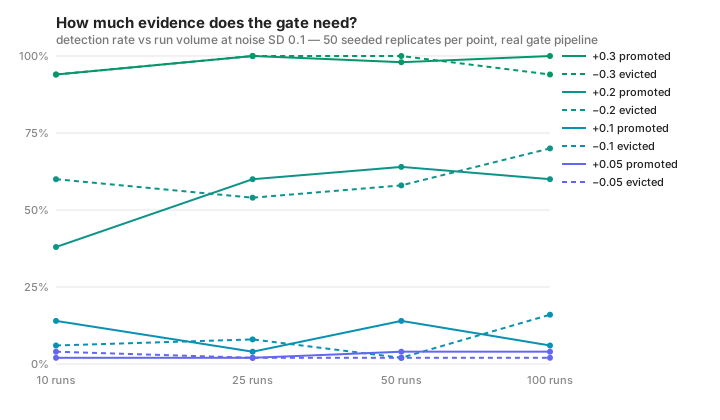
Section titled “How much evidence does the gate need?”By default the gate uses real statistical inference (decision_rule: 'inference'), not a raw mean comparison: a Welch-style test on the lift against the leave-one-out baseline, with Benjamini–Hochberg control across the candidates tested in a pass and alpha-spending across doubling baseline brackets so that gating after every run doesn’t inflate false positives (the peeking problem — our simulator measured a 25% false-decision rate without this control, 0–2% with it).
The trade-off is resolution. Measured operating characteristics with 5-trial cohorts at judge-noise SD 0.1:
| True effect | What happens |
|---|---|
| ±0.3 | correctly decided 94–100% of the time |
| ±0.2 | decided ~54–70%; the rest retired as no_lift |
| ±0.1 and below | mostly retired, not falsely decided (false decisions: 0–4%) |
The detectable-effect floor scales roughly with promote_margin + 2.6 · noise_sd / √trials_per_cohort. To resolve smaller effects: raise rest_after_trials (more evidence per cohort), reduce judge noise (more judge samples — requiredTrials() does the arithmetic), or accept that small effects get retired. Measure your own policy before trusting it — gateOperatingCharacteristics() runs the real pipeline against lessons of known effect in under a second; see packages/evals/examples/gate-operating-characteristics/.
Tuning fields on RetentionPolicySchema: decision_rule ('inference' | 'margin'), promote_confidence / evict_confidence (default 0.9), noise_floor_sd (set to your judge’s per-run SD), multiple_comparison ('bh' | 'none'), sequential_control ('doubling' | 'none'), and max_baseline_runs (closes the decision window for candidates the bracket penalty has made undecidable — pair it with rest_after_trials, since frozen trials mean max_trials alone can never fire). Every decision in the report carries an evidence object (lift, se, df, p_promote, p_evict, alpha_bracket) so “why was this held?” is inspectable.
Foot-guns:
- A retriever adapter that strips
idfrom facts records no provenance — gating silently degrades to today’s keep-everything behaviour. candidate_slots: 0means candidates are never retrieved, never accrue trials, and are held forever.- Supervisor-node retrieval is provenance-tracked: the supervisor carries a
_lesson_provenanceentry on itshandoff/set_statusaction and the matching reducer merges it append-only, so facts injected into a routing prompt are attributable to the run’s outcome just like agent nodes.
Runnable examples
Section titled “Runnable examples”packages/orchestrator/examples/learning-research-agent/— the basic loop: a research workflow that runs twice on related goals and prints a side-by-side comparison of lessons injected / extracted / tokens / cost / duration.packages/evals/examples/eval-gated-learning/— the full gated loop, adversarially tested: three poisoned lessons are seeded into the store mid-experiment and the retention gate evicts them on outcome evidence alone, with a fitness chart showing the dip and recovery.